Texas Politics
 
   
Texas Politics Speakers Series Transcripts

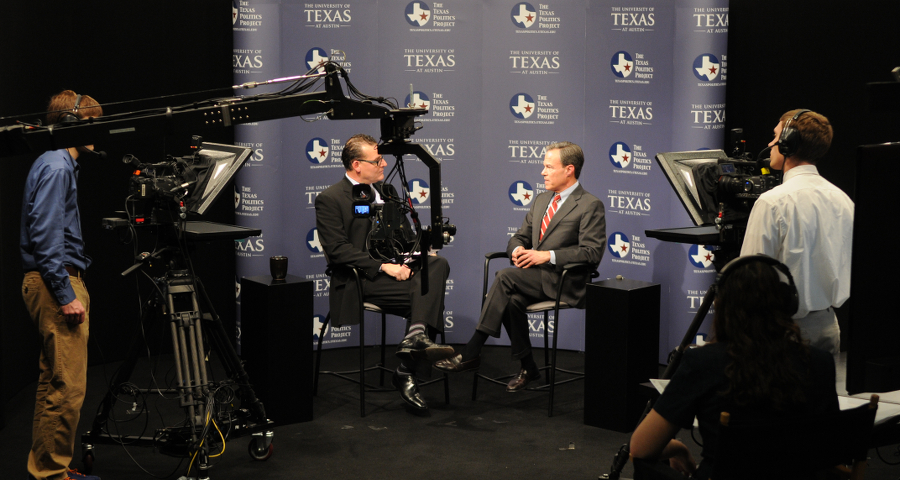
Senator Kip Averitt presented "Politics: They'll Let Anyone Do It" for the Texas Politics Speaker Series on November 30, 2006.

Dr. James Henson: I am pleased to welcome Senator Kip Averitt to University of Texas at Austin today. We've talked about him coming over here for some time now. And I'm very glad that we can make it happen.

Senator Averitt was raised in numerous cities and towns across Texas I didn't quite figure out what that meant and graduated, though, from Reagan High School right here in Austin, which explains a lot, I think. He later earned a BBA, an MBA in economics and finance from Baylor University don't hold it against him.

And in his non-political, professional life he's a CPA. After serving nine and a half years in the Texas House of Representatives, including two terms as Chairman of the House Committee on Financial Institutions, he was elected to the Texas Senate to represent the 22nd district in April 2002.

He won reelection earlier this month with a lackluster 81 percent of the vote. And I really can't mention that without mentioning the fact that his only Libertarian opponent was released from a 20-day stint in jail for violating probation just a week before the election.

That kind of tends to put a crimp in your campaigning. Still he had a week to go after it, and still could only garner less that 19 percent of the vote. Stories like that of course we all know Texas politics just gives and gives and gives.

He currently serves as Chairman of the Senate Committee on Natural Resources and also serves on Senate's Finance, Business, Commerce and Education Committees, and of special interest to us really as well as on the Subcommittee on Higher Equation and the Subcommittee on Emerging Technologies and Economic Development.

He's one of only three senators who serve on the Texas Water Advisory Council. Senator Averitt was a key player during the last legislative session. And we look forward to what he's going to be up to this session.

He was appointed to the Budget Conference Committee last session, the School Finance Tax Reform Conference Committee, which for those of you that were there was a very important committee. And the Senate Republicans elected him to serve as Vice Chairman of the Senate Republic caucus.

He played a key role 0n several issues, but received perhaps the most attention for his role in restoring funding to the Children's Health Education Program, a program which he is very strongly associated with.

I love the title and the underlying message of Senator Averitt's talk today: politics, they'll let anyone do it. And I'm very happy to save Senator Averitt here. He's a great guy. So please join me in warmly welcoming Senator Kip Averitt.

Senator Averitt: Well, thank you very much. What that meant, raised in several towns we were on the lam. With a background like that I turned my attention to politics. After that it just seemed like a natural fit. I'm very happy to be here really.

I appreciate, Jim, that you're inviting me to do this. One of my favorite things to do is talk to folks who are still in the process of their educational training. So I find these audiences very challenging.

Matter of fact college students are typically the most challenging audience that I have: inquiring, intelligent minds, not afraid to ask the tough questions, and I appreciate that.

And Jim, once again I appreciate you giving me this opportunity.

Jim and I met several years ago at the research library. And we spent a lot of time doing research at the library. And so we kind of grown a friendship there. We're both braniac kind of guys. That's what I say.

Our topic for today well, let me first get my homework out of the way. My name is Kip Averitt. And I represent District 22 in the Texas Senate. District 22 is ten counties in Central Texas: Coryell County, McLennan, Falls, Bosque, Somervell, Hood, Johnson, Ellis and Navarro.

Do we have anybody in this room from any of those counties? Excellent. We can speak freely. 700,000 people live in those counties. As you know, our Legislature is divided up into equal districts of population.

We do it every ten years. We divided it up where everybody's representing about the same number of folks. And we try to make it a series of communities of interest. My district happens to be a rural district. Waco is by far the largest town.

Corsicana is a town of about 30,000. It's the second largest town in my district. So it's pretty well a rural district no big population centers like Austin or anything like that. So I find that the issues that the folks in my district are interested in are quite different than the folks in Austin might be interested in or in Houston.

So that's what makes the dynamics of our Legislature so much fun. I was mentioning to Jim earlier that I had the privilege when I was a freshman member of the Texas House of Representatives, Bob Bullock was one of the guys who indoctrinated us at our orientation, our first learning experience.

Bob Bullock had a way about him. And he told us another story that has stuck with me all this time. He told us the story of when he was member of the Legislature, his desk mate in the Texas House was a crazy person.

And he could not understand how someone as far out and crazy and out of touch as this person was, how they could possibly be elected to the Texas House of Representatives. And then one day down the road a little bit, Bullock found himself in that guy's district.

And he found that all those people were crazy, too. They had elected one of their own. And that's the policy that's the process that we go by. What I'm here to talk to you about today is the process of how the system actually works.

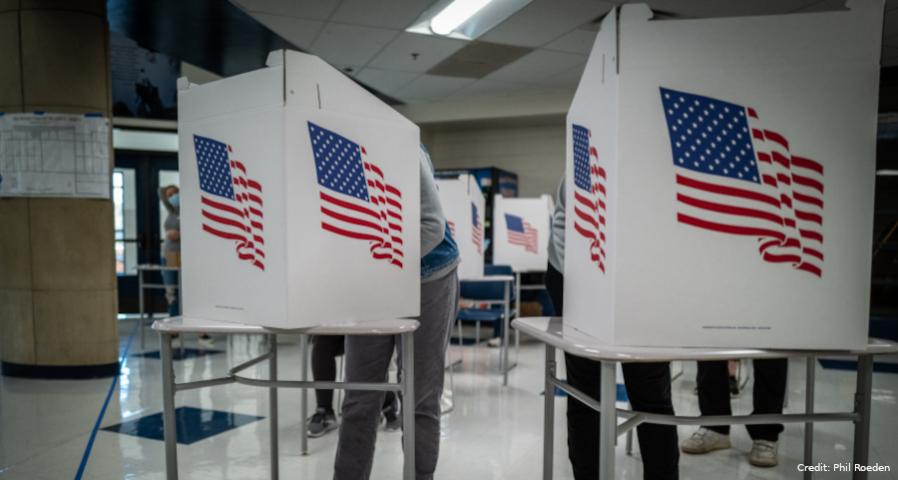
And I don't know if this is going to work since we have cameras. Is it going to be all right if I ask everybody to stand up? Will you all all stand up? What we're going to do here is just a little demonstration on how our election cycle works in the real world.

I'm sure that we've all heard the stories. We watch television and read in the media about how the process works. But the fact of the matter is, it's an interesting process. And what you all represent here are the people in our state who are eligible to vote.

You're old enough; you're citizens, and you're not felons and all that kind of stuff. So you all represent everybody who is eligible to vote in an election. Now, we have come a long way in this state in registration process.

It used to be half of the folks in our state wouldn't register. But now we do registration when you get your drivers license. And 70 percent of our people are now registered to vote, which is a good thing. The problem is there's still 30 percent that don't take the time to register to vote.

Now, the process of registering to vote is filling out your name and address on a prepaid postcard and putting it in the mail. You don't even have to put a stamp on it. That effort gets your registered. But 30 percent of the folks don't do that.

So representing those 30 percent let me ask this table to sit down, please, because you all didn't bother to fill out the card, leaving these people in charge of the election process. Now, unfortunately 70 percent register, but a far, far less percentage will actually take the time to go vote.

And our voting in Texas is extremely easy. We have a ten-day early voting period, where you can go vote. You don't have to go to your precinct to vote. You just go in. You don't have to have your registration card. All you have to have is a drivers license.

It cannot be any easier. Well, it could be. It could be online, which we may get to one of these days. Even though that process is so easy, and it's such a long extended period of time for early voting and on election day, in a really, really good election, half of the people will go and vote.

So representing the half of the people that were busy or they got sick or they were fed up with the process, or whatever their excuse might be let me ask this table and the back six people there to sit down, because you all were busy.

You all had something better to do than participate in the process. And now, this group of people are going to make the decision for everybody. But this is an interesting group, too, because in Texas one-third of these people are going to vote Democrat if the devil himself is on the ballot.

They are not going to consider anybody else. They're just going to vote for Democrats. So you three Democrats sit down right there. Now, another third of this group right here would vote for Mickey Mouse if he an R behind his name.

Don't care who it is, what they represent, what their background is. If they have an R they're good enough for me. So they're going to vote Republican no matter what. You three people, you Republicans, sit down. And there are the folks that are going to make a decision for the whole group.

And that's the way it really works. These are the people that will split the ticket. They won't know probably until they go into the election booth itself who they're going to vote for. And as a candidate those are the folks I want to talk to.

I know what you're going to do; I know what you're going to do. And we don't care what you all are going to do. These are the people that will make the decision for the entire group. Thank you very much. That's the way it really works.

That's how small a group impact the entire system. And frankly we were doing a general election. If we were doing a primary election the numbers would be far smaller. In the primary election process is where the candidates get picked.

So by the time you all get around to voting in the general election the talent has already been decided. And that's what is a scary part of our process in my view, because typically in a primary process, we are dealing with a very small group of voters, typically motivated for a narrow policy position.

In the Republican Party, you know, you hear about the far right and their issues. That's who votes in the Republican primary. And in the Democratic Party it's the far left and their issues. And those are the people who are picking the Democrat for the general election.

So our primary process is where the talent for our government gets picked. And a very tiny percentage of people actually participate in that process. It's a powerful place for you all to be. Well, you all are old enough.

So nobody in here has an excuse. And I assume that because you're in the program you all are motivated towards some kind of interest in government or politics. And that's a good thing. It all starts with voting. And then after that you all may want to take it to the next level: participating in the process.

Maybe one of you all wants to be maybe all of you all want to be elected one of these days. I kind of want to talk about that for just a minute as well. The process of how we become Republicans and Democrats I'm sure is different for every single one of us.

And what that means is something different to every single one of us. My course towards the Republican Party was well studied, thought out over a long, long period of time. I want to tell you that story. When I was five years old I begged my parents to let me stay up and watch the Democratic National Convention on television.

I had absolutely no idea what they were talking about. But I was fascinated. This was in 1960. And John Kennedy was running against Lyndon Johnson for the Democratic nomination to run for president. Well, all I knew was there was a guy from Texas running against a Yankee.

And I was for the Texan. And I was fascinated by the roll call of the states. It was a fascinating process. Didn't know what was going on. But I just thought, This is the cat's meow. I love that. But my parents let me stay up and watch.

And I enjoyed the process. A couple of months later my mom and dad were walking out the door to vote in November in the general election. And by that time it was Kennedy versus Nixon. And as mom and dad were walking out the front door I announced to them that I would be voting for Mr. Kennedy.

And my mom turned to me from the doorway. She looked me square in the eyes, and she said, You'll do no such thing, young man. That's when I knew I was a Republican. And it stuck with me all this time. I just sort of was always interested in it.

When I was at university I got involved in another presidential campaign. Ronald Reagan was running against Gerald Ford for the Republican nomination. I worked on the Reagan campaign. And they invited me to go to Kansas city to watch the Republican convention.

And that was the last convention we've had in the country that was not decided when the convention started. It was that close. I was fascinated. Anyway I kind of evolved through that process. And it had always been in the back of my mind that I would like to stay interested in it and somewhat familiar.

Maybe in the back of my mind thinking I'd like to run someday, but probably knew I'd never get around to it, or I wouldn't have the guts or whatever happened. Well, down the road a friend of mine or an acquaintance actually at my church decided to run for Congress.

And I had reached that point in my life business was good. Family was stable. I was in a position where I could go back and kind of chase that dream a little bit again. So I went to David Sibley and said, I want to volunteer on your campaign.

And he said, Great. And we talked a little bit. And then he sent me down to his campaign headquarters. And I met Becky Dixon who was the campaign manager. And I said, Becky, I'm here to volunteer. I'll do whatever needs to be done.

I have a lot of time. I just want to participate. I just want to see how the process works. And she didn't know me from Adam. She didn't know if I was a Democrat spy or a goober or what. She had no clue why somebody would walk on off the street dressed like this and volunteer full time for their campaign.

But she tested me. She said, Okay. Well, we need something done right away. We need to paint the bathrooms so that it'll look nice for the volunteers. Well, I left. She knew I wasn't coming back. But I changed my clothes.

I got my paint brush. And I came back, and I painted the bathroom. And that was my first job. Two years later I was elected to the Texas House of Representatives. I'm telling you they will let anybody do this.

It's nuts. Anybody can do it. Very, very few people play this game. Of the few that vote a tiny, tiny percentage of those would actually volunteer to do work on a campaign. And then a tiny percentage of those would actually put their name on a ballot.

And this is not rocket science, let me tell you. When David Sibley got finally elected to the Texas Senate, I was his chief of staff. And I just went to Austin to say that I had seen it up close and personal and that I actually had an opportunity to participate in some small way in the legislative process once in my life.

And he served through that session. I resigned my position at the end of the session, because I had done what I wanted to do. And afterwards thought about it, and I said, You know what, if those knuckleheads can do it, so can I.

And I put my name on the ballot the next time, and I got elected. So just paying attention, just going around meeting a handful of people in Waco who made the process work. It was that easy. There's no rocket science about this.

It's about your involvement and your concern about your community and your neighbors and your family. And there are no qualifications other than being a citizen and of age. And it's really a process that's open to the public.

And I can't emphasize enough how easy it is for people that want to participate in the process. So it's a fun deal. Politics is a study in human nature. I get very, very frustrated being on the inside and having to deal with the perceptions of being a politician.

We all know that politicians are crooks. They're out to enhance their own personal wealth, their own agenda, whatever it might be. T'aint so. There are some. It's an unfortunate process. But the fact of the matter is you get a few bad eggs in there.

And those are the ones that really, you know, we hear about. The news folks aren't really all that concerned about telling you the happy news. That's human nature. We don't want to see a bill for a new crosswalk that make children safer in East Austin.

That's not interesting. What's interesting is a guy that took $1,000 in cash under the table. And that's what we hear about more often than not. Politics in Washington, D.C., is light years away from politics in Austin, Texas.

In Washington, D.C., Republicans and Democrats are for the most part my perception it's a party machine. The Republican Party says, You're going to vote this way today. And the Democrat leadership says, Democrats are going to vote this way today.

They literally in many cases get a sheet every morning telling them how their votes are going to be. I don't understand what the purpose of them is at that point. But they sit, Republicans on side of the room, Democrats on the other side of the room.

They have a lounge for the Democrats and a lounge for the Republicans. There's no intermingling. There's no working together. Everything it's all or nothing in Washington, D.C.

When we just had our orderly change of power in Washington from a Republican-controlled Congress to a Democrat-controlled Congress, every chairmanship in the entire House of Representatives changed hands. No more tenure in those positions.

Well, there's tenure certainly on the committees, but no leadership tenure. When the Republicans are in charge every chairman is a Republican no Democrat chairmen. Every committee is stacked with a Republican majority.

And when the Democrats take power, it's just the opposite. Every chairman is a Democrat, and every committee is stacked with a Democrat majority. And that's how they get their agenda passed through the process.

And when you do it that way, there is really no need to deal with the other side, there is no need to deal with the minority party. And hence it's all or nothing. It's blood and guts. If you want to be a player, if you want to get your agenda through there, you have to win the election.

And we will do anything to get that power back. And we all know what that process is like. It's ugly. It's brutal. It's not necessary in my opinion. In Austin however we don't do it that way. In Austin if a third of the membership are Democrats, a third of the chairmanships are going to be Democrats, and vice versa.

It's proportional. And what that does, along with our rules that we have, it forces us to work together. We are required to deal with everybody in the Senate. There are only 31 senators. And we have to deal with each other every day.

We have to negotiate with each other every day. And what that ultimately results in is a bipartisan effort that reflects the values and priorities of all of the members. There are no black-and-white issues, by the way.

What my constituents and I might think is a common sense, black-and-white, no-nonsense answer to a complicated problem is the worst idea that a guy in the valley ever heard of. He hates it. But it makes sense to me.

So we have to work it out, because I have to have his vote. And he has to have my vote. And that makes for a much healthier process. So I was real disappointed when Governor Bush went to Washington. I know that he in his heart had the idea of bringing that type of working together to Washington, D.C.

But the fact of the matter is that the process is institutionalized in Washington. And it just doesn't work that way. Maybe one of these days there might be a wholesale change in attitude, which we've had here.

We've had a majority of House members, 76 members, elected in one election cycle before a majority being freshman, a majority not institutionalized. They're not stuck on anything. They can do whatever they want as a majority.

It's probably going to take something like in Washington, some kind of really major change or the growth of a third party to shake things up in Washington, D.C. I happen to be very proud of the way we do our business in Austin.

We also do our ethics differently. Ethics are a big issue right now. Ordinarily in our election cycles every two years there's always scandals. There's always somebody who's doing something he ought not to be doing or she ought not to be doing.

And usually it's Democrats and some Republicans. It's usually a good mix of folks. Well, this time it wasn't. This time it just so happened they were all Republicans. And that didn't bode well with the voters.

And I think that had a huge part of the change in power structure in Washington, D.C. And that's the frustrating part for me. I was getting around to the fact that the perception that we all have is that politics are like they are in Washington, D.C., where it's so marginalized and so party-driven.

And what they're doing in Washington, D.C., what the Republican Party doing in Washington, D.C., must be what I as a Republican from Waco, Texas, believe in the Texas Senate. And nothing could be further from the truth.

But we're branded with that. And how people deal with that back to my original statement is a very interesting study in human nature. I enjoy my job. I like going to Las Vegas just to watch the people, too. There's another interesting study in human nature.

It's a fascinating process if you're inclined towards that kind of stuff. It can also be a very rewarding career or whatever it might be. You're not going to make a career out of it. I get paid $600 a month before taxes and insurance for $350.

So there's a whole other problem there. We really cut out a lot of talent, a lot of people who might be good representatives, senators who can't live on $600 a month. I've been very blessed, been very lucky. And I can come to Austin and do this full time.

It's a full-time job. But a lot of people who are highly qualified and would be great talents cannot do that. There's no way for someone to come here and try to make a living here and succeed legally. If you see somebody who's getting by that has no other means of support might raise an eyebrow.

But it's a tough way to serve. Now, I want to talk about one more thing before we open up for questions. And that is some of the way that we develop our policy positions, very interesting. It's very amateurish actually.

A lot of our policy decisions are based on rumor or suggestion or perception perception being the huge part of how we develop our policy positions.

I'm sure that we all like to think that our senators and representatives spend day and night reading reports and studying issues, and that the staff is studying issues, and that they know all the details and both sides of every issue.

It doesn't happen that way. There are some folks that spend a whole lot of time doing their homework, and it shows.

But there are a whole lot of other folks that, because of restraints maybe they have to go back to their district and make a living or be with their family or whatever don't have the time to spend studying all of those reports and doing all of the homework and spending all of the time that's necessary to get into the subject matter.

Plus there's so many subjects. We do 5,000 or 6,000 bills every session. You can't read 5,000 or 6,000 bills and know what they mean. There's no way. And so when you don't know that's where the lobby guys come in. And lobby has a very negative connotation.

But I would suggest everybody has one. I don't know about university students. You may be the only ones in the whole world that don't have lobbyists, besides children. But everybody else does. And there are good lobbyists, and there are bad lobbyists, just like everything else.

A good lobbyist I depend on very heavily to come in and tell me their side of the story on issues that I don't know everything about. You all probably know all of the intimate details on developing a low-level nuclear waste site in Andrews County out in the Panhandle.

You all may all be up on that. I'm not. So if you have to make a vote on that, what are you going to do? How are you going to make an intelligent vote on something like that that you may not know about. People are depending on you to make a decision.

You got elected to represent your people in a decision like that. But what you're going to do is you're going to have the lobbyist come in and explain things to you. And hopefully you're going to hear both sides, because everybody's got both sides.

That's how they make their living. It's a very capitalistic process when you get down to that level. Both sides hire up talent. They're like salespeople. They're talented people. Some of them are very intelligent, articulate, respected.

They come into your office. You trust them. Trust is the main thing they have to sell. Then there are others that aren't quite as trustworthy. And you may take what they say with a grain of salt. That's the process. That's why you got elected.

Ultimately your people said, we want you sitting in that room weighing the evidence and using your good judgment and remembering our values. And that's what we want you to do. That's what we want you to rely on to make a judgment in those kinds of cases.

That's ultimately the job. And it's a lot of fun. However, sometimes the public has made up their mind, no matter what the evidence is, because of a perception. I'll give you three examples. If you are from East Texas your representatives and senators absolutely cannot vote to repeal a clause in our water law called the junior water rights.

I'm not going to explain what that means. But I'm just going to tell you it's suicide for a guy from East Texas to suggest that water can be transferred from one river basin to the next. They don't like that idea at all.

They have water there. They want to keep the water there. Water is economic development and life. They don't want somebody selling it to another area for economic development over there. They want it right there in their back yard and economic development for their area.

It doesn't matter that Dallas absolutely has to have that water or San Antonio or wherever it might be, and that that's a marketable commodity that, like oil, can be sold and benefit their communities. That doesn't matter.

They've already made up their mind, that is not going to happen. In my district the Trans-Texas Corridor is going to take up valuable farmland and kill every poultry animal within ten miles of that highway and fester communism and all kinds of evil, evil things.

And if I vote for that my people will have my hide. Now, although I recognize Interstate 35 is a deathtrap, and it's getting harder and harder to drive on that, and our options there are less and less, my people have decided that Trans-Texas Corridor is not the option that they want me to pursue.

So that weighs heavy on my mind this coming session. Folks in Dallas representatives, senators from Dallas will not be allowed to endorse or support the building of coal plants for our energy, because they've been told that their babies are going to have three eyes and going to create thousands and thousands of people are going to have asthma and die, because there are coal plants.

The fact of the matter is those coal plants are almost squeaky clean. There are some problems with them, I'll give you that carbon dioxide for one. We haven't solved that one yet. But compared to coal plants of 20 years ago, they produce about 96 percent loss regulated emission than they used to.

They've come a long way. And there's technology being developed that will take them even farther. So folks in those cities have been the public has said, Nope, if it's coal, it's got to be bad. I don't really care what the emission levels are.

I don't care what you say they are. We don't want coal. So radioactive for them. They can't vote for that. So sometimes we are forced to decide whether or not we're going to pursue what our public perceives is the right thing.

Or are we going to do what we think is the right thing. Are we elected to represent what you think, or are we elected to study and judge make the decision. Are you electing me because you trust my judgment.

I think you're asking me to study and use my judgment, because you can't possibly have the same information that I have, because I do it every day. You may know more about something than I do. I don't know very much.

I'm kind of dense that way. And there are a lot of people that know a whole lot about every subject, a lot more than I do. But I happen to be in the position where I get to filter, collect, analyze the information and be in a position to make those kind of decisions, judgments.

So it's an interesting process. There's a lot of pressure, a lot of good opportunity to grow gray hair or lose your hair. I had hair when I started. I sure did. But it's also very rewarding when you can help people.

Jim mentioned the Children's Health Insurance Program, a great program that helps working families provide health insurance for their children. There are some people let's face it, health insurance is an expensive proposition.

There are some people in this state who are doing the very best they can. They're working. They're helping pull the wagon. They're paying taxes. But they just can't afford health insurance for their children. And it is not out of the realm of reason and compassion that we couldn't help them a little bit with health insurance.

And quite frankly it is a very sound economic decision, because we get a lot of federal matching money, our money back. It prevents we all know the benefits of health insurance. It prevents more serious illness. It prevents illness period in a lot of cases.

It's just a lot better deal. Makes good economic sense. When you get a chance to do something like that that helps people, that's what makes the job worthwhile. And I love my joy. And I love coming and visiting with you.

I look forward to your questions. And if you want to talk about coal plants, I'll be happy to do that, too. Any questions?

Dr. James Henson: I want to start with something this is going to be kind of a boring question, while people think about more interesting questions. It's not boring. But it's process-driven a little bit. What do you see coming up?

It seems I'd be remiss to not ask you here with a session coming up what you see on the agenda for the Senate.

Senator Averitt: We have several pretty juicy things to do. We did a tax bill last time to replace property tax with a new business tax. That thing's got a thousand problems with it. And one of our major functions is going to be to go back in and dress that thing up and make it presentable before people actually have to start paying the tax.

So that will require a lot of energy and time. Every special interest will be in Chairman Ogden's office saying, we're special. This is a little deal. It's only going to cost $5 million. And it's really not fair blah, blah, blah.

And then the next guy's going to come in and say, our situation is totally different than everybody else's. It's only going to cost $4- or $5 million, and so on. They'll be a thousand of those. By the time we get through it, he could rewrite the bill altogether.

So it's going to be an interesting process there. Air and water are going to be very, very important issues this time. On the water we've done a really good job of planning for a water plan to plumb our state 50 years into the future.

We're way, way behind in infrastructure. There's areas north of Dallas. Hundreds of thousands of people have Lake Lavon as their sole source of drinking water, and it's almost dry. We can prevent that with good planning and implementation.

We've done the planning, excellent planning throughout the state. The plan's adopted. Now, we need to fund the implementation. And one of my top priorities this time will be to fund the water plan for the State of Texas.

And that will spur with a lousy $78 million we can spur $30 billion worth of infrastructure development. And that's a pretty significant economic development initiative as well. And $78 million in our budget is we spill that much.

It's a very small drop in the bucket. So money well spent. And that's going to be one of my top priorities. And then the other one is a very aggressive air bill that will focus on mobile sources. Car technology is another fantastic story.

A 2000 model car produces 14 times as much emission as a 2007 car. You can imagine if you start going back past 2000, those numbers get even bigger. Fourteen times just in seven years. And the 2009 model car will do half as much as the 2007.

That's how our air is going to get cleaner. Incredible technologies and fuels and catalytic converters and the whole technology of our automobiles. They say on the new cars the harmful emissions the regulated emissions I'll say happen in the first ten to 25 seconds of when you turn on the car.

After that they catalytic convertor is heated up, and there are no more NOCs or sulfur dioxide emissions. And that's an incredible story. Now, what do we do? We need to speed up the vehicle fleet turnover. We need to get those old cars off the road.

A lot of people can't afford a new car. But the taxpayers have been paying into a fund, the Clean Air Account, for the purpose of incentivizing and helping people get their old smokers off the road and replace them with new, clean cars.

And by doing that we can save a lot of emissions into our non-attainment areas, which are the Dallas area and the Houston area. And by doing that then we will accelerate our process towards meeting our goals that the EPA has set up for us for our air standards.

So we're going to have a very aggressive effort to get as many as those old cars off the road as we possibly can. And there's another pot of money that you all have paid into called the TURP Program. It's also a clean program that over the last two sessions we have not spent the money.

We need to spend it now. Deadlines are coming up. The money's sitting in the bank not doing anybody any good. We don't have to raise any taxes. The money's already there. Now all we just need to do is put it to work. So that will be a top priority as well.

Amanda: Hi. My name is Amanda. I have a question regarding voting turnout. In your opinion how many of the current representatives and senators would have still gotten elected had the voter turnout been like 50 percent or even 40 percent?

And subsequently what is the incentive or is there even an incentive for politicians to increase the general voter turnout and get more voters out, who may or may not support them?

Senator Averitt: That's really a good question. I don't think that I can definitely answer the first part of your question. I would expect there would be more turnover had turnout been heavier. I think a lot of the reason that our voter turnout is so low is because people are disenfranchised with the system.

They think they're all crooks. So one crook versus another crook doesn't make any difference. They're not going to participate. Now, if those people ever decide that the crook in the office is worst that than the crook that we don't know yet, then there will be more turnover.

And what incentive do we have to increase voter turnout? Well, here again that's everybody will probably look at that not everybody a lot of people will look at that in a self-survival type of situation. Back in the day when we decided to do motor voter, where you registered to vote when you got your drivers license, Republicans were scared to death about it.

Oh, my gosh. We're going to let anybody vote. Well, yes. It's America. We will let anybody vote. All they have to do is sign up. But what happened was, with that and early voting it made the process easier. And quite frankly the Republican Party has done quite well under that scenario.

And I suspect that as we increase our effort to bring people into the system our government, we get what we deserve. I mean, that's as simple as it gets. If we don't participate in our governmental process, we get what we deserve.

The more people participate, the better government is going to be. The more reflective it will be of the will of the people. And there are things we can do it to help that. And ethics reform is a primary part of that.

There are many things that we can do. We do a far better job here in Texas than they do in Washington on that as well. We can't take campaign contributions during session, 30 days before session. Washington, D.C., they can raise money year-round.

They can have a fund-raiser the night before they go vote on the bill, and they do that. They can do better. We can do better as well. One of our interesting issues that we're going to work on this next session as well is whether or not you have to have a [holding up license] photo ID to vote.

Your drivers license is good enough to vote. But how many of you all are carrying your voter registration card on your person right now? Nobody. Me either. None of us could go vote if we had to have the ID card with us right now.

But you can if you have your drivers license. We have a big issue that, should we require a photo of the person who's voting. Many of us think that that would instill confidence in the system, that we know that they people who are voting are voting one time.

They're voting we're they're supposed to be voting. In this electronic age it's not that hard to do. Democrats are really afraid of that one. When Senator Whitmire's here the next time, I'll let you ask him by the way, I encourage you to come here.

Senator Whitmire, he's a very effervescent personality. Great guy. But anyway that'll be a big issue this next session as well.

David: My name is David. You were just talking about ethics. I just want to know your position on the Ethics Commission's recent ruling that checks, the denomination of the check does not have to be disclosed. And you can just write a check, and that's suitable. What do you think about that?

Senator Averitt: I think that is outrageous. It flies in the face of everything that we try to do. His question is, Ethics Commission said that a guy who gets a check, who has to disclose gifts, can simply say he got a check. He doesn't have to say how much the check is for.

He got a check. And the Ethics Commission said that was okay. Now, if somebody came and gave me a whole stack of these, do I just have to say, [holding up twenty dollar bill] piece of paper? I think under the ethics rules I don't know what the difference is.

I think it's outrageous. It shouldn't even be necessary for us to go and pass legislation to clarify that. But if we must, we will. I don't know what they were thinking. They were smoking those left-handed cigarettes at the time.

David: The Ethics Commission or the legislators that wrote the law?

Senator Averitt: No. The members that wrote the law, I think, had a pretty clear idea that they need to be disclosed.

Katy: I'm Katy. Going back to the coal-burning plants, I want to ask you before the election Rick Perry signed a contract with of fast-track contract allowing 19 coal-burning plants I think the percentage was like 30 percent emissions increase. I wanted to know what you thought about that.

Senator Averitt: Actually TXU says it will be a 20 percent decrease. And let me tell you how they achieve that. We have old plants that are producing electricity today. They're two in my county gas plants for example they're small. But just a couple of years ago they were producing at a rate 78 tons a day.

They can put four coal plants in that will emit half as much as those two small gas plants. Now, the only way we're going to get those two gas plants, those dirty gas plants off of the line is to replace them with new technology.

Now, I'm talking about regulated emissions. I'm talking about NOCs, sulfur dioxide, mercury. Gas doesn't burn mercury. There are no mercury emissions in gas. And carbon dioxide is an issue. Carbon dioxide is not currently regulated.

So there are no permit requirements there. But on the regulated coal plants, the best way that we're going to reduce emissions today is replace old plants with new plants. And the technology just like in cars has come a long, long way.

And we expect that they will reserve space, provide the ability for those plants to be retrofitted when better technology comes along, like IGCC or carbon dioxide sequestration or things of that nature. Do we need all 17 of them right now? Probably not.

The fast-track process everybody's going to have their say in the process. Everybody gets to go to public hearings. There going to be meetings and contested case hearings. The fast-track scenario says the contested case hearing process is going to be limited to six months.

It's not going to drag out for two years. So the judge has six months to decide what his position is. Then after that there'll be appeals process and all that. So I don't think the system is getting short-changed any. But the word fast-track permitting is stuck on people's mind.

But that's the scenario there. Does that answer your question? Not satisfactorily?

Katy: No. I'm just curious about the fast-track process. I was under the impression you were allowed to use old technology. I mean that's what I was told. So I was assuming that was the case in which they wouldn't make any improvement.

Senator Averitt: No. That is not the case. Each plant has a permitted level of emissions of nitrous oxide, sulfur dioxide, mercury, VOCs, particulate matter. It's all regulated. And the permits are defined.

These new plants also are going to have online, realtime monitors, so that the regulators and anybody else that wants to see what's being emitted, can go on their computer any time of day and make sure that those plants are being true to their permit levels.

So it's really a step forward. My children live there. I have absolutely no interest in dirtying their air. And there's been so much effort and resource on trying to clean up our air in our non-attainment areas like Dallas and Houston, I will not under my watch allow us to take a step back.

If I did not have confidence that taking those old plants off was a good idea, then I would not be supportive.

Cindy: My name is Cindy. You mentioned that you only make $600 a month, and that this probably discourages very qualified people from seeking a job in the Texas Legislature, and that it may contribute to corruption in certain individuals.

Do you see any time in the near or distant future the possibility that the wage that you make could be raised or somehow make it easier for more qualified individuals to seek office, so that each individual would spend less time at work and have more time to become an effective legislator? Do you ever see that being possible?

Senator Averitt: I hate it when you pay attention to what I say. It is possible. It is politically not feasible.

Cindy: I realize that. That's why I asked.

Senator Averitt: That would require members voting themselves a raise. And we all know what that would lead to. Now, there is another way around that. You could grandfather current members at their current level of salary.

And the next guy or gal would benefit from the raise deal. And it would just be phased in. It's possible. I don't see much movement in that direction though.

Cindy: Do you see any sort of change that would make it easier for people who can't afford to live on a $600 salary and be required to make a full-time job of it?

Senator Averitt: You know, other than just increasing the salary. The State of California has a professional legislature. They're very much like Washington, D.C. They're pretty full-time, and they get paid 150-, $160,000 a year.

And quite frankly I don't see anything in the California Legislature that I would like to mimic. I just don't see any momentum there to move in that direction. Now, when the public asks for it, that's when it will happen.

Allison: Hi. I'm Allison. I just had a question about as far as your terms in the House and the Senate and voting, feasibly what you were saying about the perception and the rumors.

Basically like the percent that you have to vote for or against a district whether like a district has an unfounded or uneducated perception about it, versus your knowledge about it. And basically how often have you had to do that?

And maybe what is the biggest situation where you had to either vote one way or the other?

Senator Averitt: Well, it has happened to me. I suppose it happens to everybody, and everybody handles it a different way. But I think that's what leadership is about. I voted for the Hate Crimes bill. I thought it was an appropriate thing to do.

Not so popular in my Republican district. I also carried a bill several sessions ago to increase the gasoline tax by 5 cents. Obviously not a good Republican bill to be carrying a tax bill. But I thought they were the right things to do.

Our roads and infrastructure are way behind. We didn't do the gasoline tax. So now we have toll roads instead. And the toll roads cost you 15 cents a mile. My proposal was a nickel a gallon. So the Legislature made a choice.

They didn't go the way I wanted to. But what I took back to my voters and I had a very serious Republican primary challenge. And those were the two issues that he ran on, that I voted for the Hate Crimes bill, and that I wanted to raise taxes.

But I was comfortable and confident enough to explain to the public what my reasoning was on both. And ultimately I kicked his butt.

Dr. James Henson: We're going to wind down here pretty soon, Senator. But I want to go back to something you said in your talk and ask you a little bit more about it. You were comparing Austin to D.C. and the difference really in the level of partisanship.

We've had a lot of people kind of sit up there and you and I have talked to plenty of people that we both know some of the people that sat up there that talked about how in fact things have really degenerated quite a lot at the Capitol in the direction of things the way that you were describing things in Washington.

Can you talk about why you think if you think that's the case. And if so, why? In other words, what shapes the atmosphere and the level of partisanship and fighting. And do you think that maybe you're a little more insulated from that in the Senate.

Senator Averitt: I definitely feel more insulated on the Senate side. And there are some fundamental differences between the House and Senate. Our rules in the Senate are quite different than they are in the House of Representatives.

And it is also a function of leadership style, both from the majority party and the minority party. When I was in the House Democrats were the majority party, and we were the minority party. Pete Laney was the speaker. My experience was that any member could carry any bill that he was big enough to carry.

Certainly the speaker had some positions on issues. But he allowed everybody opportunity to participate. And on the minority side not everybody felt this way by far but I think the majority of the minority party felt like it was a fair system.

It had been that system for 150 years. The Democrats had controlled the House for 150 years. It was pretty institutionalized itself. Now, when you have an election and things change, you have a new speaker, a new party in process, there are going to be rough times.

There are going to hard feelings, payback, obstructionism all kinds of factors that were not prevalent or prominent in previous sessions. So the members of the House had to work through that. I think they're still working through it.

I do believe it's moderating hopefully to some degree. But also the people in Texas have voiced some concern about the way things are going. A lot of incumbents have lost their job through election process a higher number than normal I would suggest.

And I would expect that the membership of the House will be paying attention to the way that the public is reacting to that scenario.

Dr. James Henson: Anybody else?

Senator Averitt: I thoroughly enjoyed being with you today. Thank you so much.

Dr. James Henson: And thank you, Senator.

Texas Politics:
© 2009, Liberal Arts Instructional Technology Services
University of Texas at Austin
[Home | About | People | Speaker Series]