After WW II, US manufacturing managers assumed they were the greatest and became smugly complacent. Because the Japanese and European manufacturing plants were destroyed during WW II, the US firms initially had little competition and US firms could sell all they could produce. The US made no attempt to innovate new approaches to manufacturing. In addition, US firms padded the number of levels of management to justify higher salaries for the top managers and build bigger empires of flunkies reporting to each manager. They granted organized labor wage settlements out of line with productivity advances. Until recently most US business innovations were in the area of finance with the automation of asset markets, corporate mergers, and junk bond finance.
While the US manufacturing firms went to sleep, the Japanese built new plants with an innovative approach to manufacturing. These innovations in manufacturing should be considered as important as the 19th century US innovations in assembly line manufacturing and replaceable parts.
The Japanese new production philosophy was built on revolutionary approach to quality control, flexibility and short product cycles. We have already discussed the Japanese reorganization to achieve total quality control in their products.
a. Flexibility: The US standard for manufacturing was to organize very long production runs to reduce the unit cost of setup. The Japanese philosophy has been to create plants that could switch from producing one product to another quickly. This eliminated the need for production for inventory. (Japan with much higher cost of land than the US has very high economic incentives to save space.) The economic value of flexibility is that a firm can produce for final demand and not for inventory. Better matching of supply and demand results in better prices and greater profits.
b. Short product cycles: The Japanese firm organizes the design and development of product in a design team that has representatives from all functions of the firm. The team leader has the authority to make decisions. Coordination between the various aspects of the firm is automatic because they are represented in the design team. A problem in the previous organization for design was that the design team would finish the design and present it to the manufacturing engineers to set up the production process. The manufacturing engineers would take one look at the design and send it back to the original designers with the comment we can not make this. The two groups would then redesign a product which could be manufactured. With design teams the coordination takes place before the design is released to manufacturing.
In contrast, until recently the US firm with its multilevel hierarchy had no one in charge in the design process. Conflicts would be resolved by vice-presidents. Moreover, design was not coordinated with other aspects of the firm such as manufacturing.
Since the 1980s the US manufacturing firms are playing catchup with the Japanese. The one area in which we are ahead in software development in CAD, CAE and CIM. The main US problems are:
a. Defective primary and secondary education system:Since the National Commission on Excellence in Education published a report Nation at Risk in 1983 condeming US primary and secondary schools as the type of schools our worst enemy would create for us, there has been a movement towards excellence in primary and secondary education. As discussion of primary and secondary education is frequently heavily influenced by the political agenda of the speakers, you should be very wary of taking the various claims at face value. Let us discuss the issues:
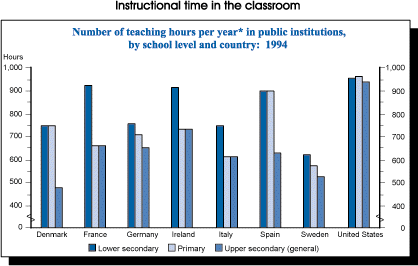
a. Length of the school year: Primarily and secondary students spend on average 178 days in school a year, whereas most European children are in school over 200 days and Asian children over 240 days. But the OECD has produced a table showing that US children are taught more hours of instruction per year than many European countries. US children go to school for longer school day than their European counterparts.
My understanding is that the US summer vacation, based on a long gone agrarian society, is so long that students tend to forget what they learned and must be retaught in the fall. As I see it the problem is creating a longer school year is finance. Teachers would have to be paid more and the public is not willing to fund this move.
b. US pays more to educate students and most of this extra cost is administration. In 1990 the US spent $5521 on pulic school education more that double (corrected for inflation) spent in 1965. The increase went to:
The residual of about 11% may well have gone to increased bureaucracy.
In considering the cost per student, you should keep in mind that in most states there is a tremendous variation in expenditures from the poorest to the richest district. Poor districts would do better with greater resources.
c. US students test at the bottom in math and science. In 4th grade US students test well in science and math, but by the time they are seniors they are at the bottom. But, US students are near the top in reading.
In considering these statistics, you need to remember that other countries tend to have more elitist educational systems where college bound students are selected at an early age and the rest are sent to vocational schools. One issue is whether the comparisons are representative. There is also a question how statistically significant the differences are with Europeans. Japanese study extremely hard in secondary school because the University that they enter determines their career. In the US Universities such a UT definitely pick up the pace from High School.
d. Improvements since 1983.
e. In informational society, if you do not have a good education, you are unlikely to find a well paying job. There is a great deal more that needs to be done to improve primary and secondary education. The conservative agenda is pushing for much more change that the liberal agenda.
In considering increased competition, you should remember that the Japanese primary and secondary education system is public. Research indicates that vouchers are primarily used by better off, better educated parents to take their children out of poorer performing schools. How well vouchers would work on a wide scale is an open question. Many parent may wish to place their children is schools where they are happy rather than obtain the best education.
Certainly we have a long way to go in primary and secondary education.
b. US MBA students are taught finance. The best MBA students until recently wanted to go to Wall Street and only the rejects went into manufacturing. Moreover, US managers have a short planning horizon that precludes making the necessary investment to innovate in manufacturing.
c. Accounting for Automation: Until recently, US accounting practice in manufacturing was defective because accountants were placing a value on automation expenditures only for reduction in direct labor. They placed no value on increased quality control and greater flexibility.
d. Poor Management-Labor Relations: Until recently the US management style was top down in that managers gave orders to workers and rarely listened to them. Labor unions created rigid work rules that made reorganizing the workplace very difficult. In addition, executive privileges angered the workers. For example, Japanese executives listen to workers suggestions, eat with the workers in their cafeterias, do not have executive parking lots, and take pay cuts themselves before asking the workers to take a pay cut.
Since the 80s, surviving US manufacturing managers are making a painful transition to world class status in manufacturing. Accounting practice in manufacturing has been upgraded. Manufacturing firms have been reorganized to imitate the Japanese with design teams to obtain better products in much shorter time. Business leaders are now painfully aware that they must work with politicians in order to improve the educational process. Universities are now emphasizing manufacturing. We are talking about a decade or two before significant progress in education reforms will be realized. That is why as a patriotic citizen, it is my duty to get you students to do some work!
Innovation in automation is a difficult task for a firm because a major renovation of an old plant is expensive, and creating a new plant is very expensive. To achieve sufficiently better performance such that the investment can be considered an innovation, requires much practical learning through experimentation to achieve the potential of the new equipment. Because firms need to justify their investments to stockholders, they need to achieve better performance within the time span of a year or two. Given the constraints on managers, manufacturing innovations are generally a sequence of small advances.
GM through its mistakes illuminated the problems of manufacturing innovations. GM, early in the 80s, set a bold strategy for manufacturing innovation. They were going to make major steps to automate manufacturing operations to achieve two objectives. First, they would leapfrog the Japanese, and second, they would solve their labor problems (rigid work rules and a rigid seniority system) by eliminating labor as a significant factor. After a $40B investment the magnitude of GM's mistakes are now apparent. They tried to advance automation too quickly. They implemented production technology that was beyond the state of the art. Because the technology was untried, they had to spend $Bs getting it to work. Instead of running factories to produce goods to make a profit, they were forced to run the factories as experiments.
To make matters worse, GM entered an agreement with Toyota to make Corollas and Prisms (Novas) in an old factory in California. Toyota supplied the managers and GM supplied the workers. The Toyota managers modified Japanese style management, which emphasizes teamwork, flexibility and good upward communication, to achieve Japanese levels of quality with little automation. Toyota immediately used the acquired knowledge of North American laborers to set up successful factories in Kentucky and Ontario. GM finally wised up and used the new management labor relations in their successful Saturn plant.
Innovations in manufacturing require much more than trying to replace existing equipment with more automated equipment. A major source of innovation in manufacturing is better organization and better use of humans. One example of an organizational innovation is the creation of decisive design teams with executives from all parts of the firm. This greatly reduces the design time are results in market-oriented products which are easier to manufacture. In organizational areas US manufacturing firms are imitating Japanese firms.
Automation will gradually decrease the cost of batch production to the level of mass production and create much greater flexibility in manufacturing. Flexibility is needed to enable suppliers to more rapidly respond to changes in demand. For example, Chrysler spent $160M to enable an assembly plant to shift between two types of cars. In the limit (several hundred years), you will be able to design an object at home and have the object manufactured automatically at mass production prices.
Since the manufacturing renaissance started in the Reagan administration, manufacturing productivity yearly increases have risen to historic levels. Many factors contribute to productivity improvements: