Objective: Discuss the impact of automation on the income distribution. The index for this section is:
Shift in emplyment
a. Agriculture
|
__Date__ |
__% total emp |
|---|---|
|
1820 |
70 |
|
1900 |
40 |
|
1995 |
2 |
b. Nonagriculture
|
__Date__ |
__% mfg__ |
% services |
|---|---|---|
|
1920 |
55 |
45 |
|
1980 |
28 |
72 |
The vote
Men: England: Men after 1850 Disrali
US: Few restrictions
Women: In both countries after WW1
Productivity Paradox
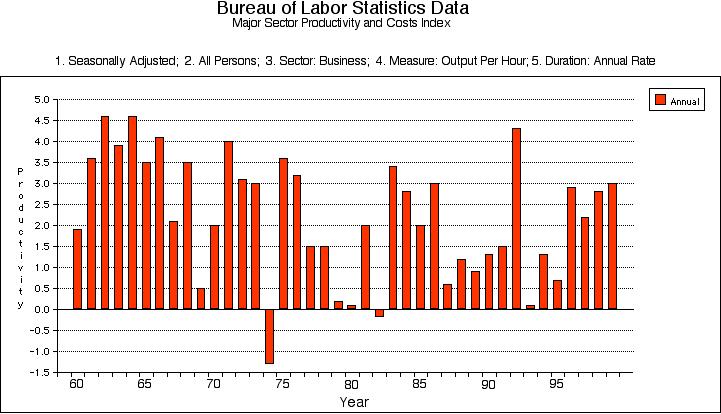
The data shows a downward trend since the 60s that may have been reversed since 1995. There are several explanations for this paradox:
Paul David, "The Dynamo and the Computer: An Historical Perspective on the Modern Productivity Paradox," American Economic Review: Papers and Proceedings (May 1990) points out that it was decades after the introduction of the electric motor that business reorganized production using electric motors to increase productivity.
Future productivity advance: Services through the WEB. Productivity of services is not properly measured. Another problem is the improving quality of goods.
Displacement will be from routine tasks not creative tasks. Routine paper pushing and sales will be hit the hardest in the near future. Manufacturing employment will gradually decline.
Some interesting sites to surf for the change in the income distribution are:
Since the proposed modifications to government would take several decades to gain popular approval (if ever), the governmental design is proposed for the forecasted political economy of the mid 21st century.
We assume that the communication system will be a high capacity fiber optics system integrating all forms of communication. Through this communication system, individuals can access all of societies store of knowledge and entertainment.
Most individuals will have much greater freedom of location than today. As organizations become communication networks, information workers could live vast distances from the physical location of their organizations. As I assume the workweek will continue to decline to say 20 hours a week, even blue collar workers will have greater freedom of location. They could work a week of say 60 hours and then have two weeks off. They might commute great distances for the one week and board.
I assume the US will partially solve its social problems to return to rising real incomes, which promotes a politically stable society.



Next: Community
Up: Informational
Society Notes Previous: Automation:
Information
norman@eco.utexas.edu