Objective: To demonstrate the manufacturing innovations are frequently processes that take decades to become commonplace. The current trend to automation is not such displacement of labor by machines. It is the shift from production for inventory to production for final demand. Each manufacturing innovation generally requires a complete reorganization of the work to become efficient. The human factors are just as important to success as the technical factors
We start by considering a 19th century innovation in order to illustrate that major innovations frequently require continual technological advances and may take decades or even a hundred years. The first half of the 20th century manufacturing firms expanded from single to multiple products. Manufacturing innovation in the second half of the 20th century based on the advances in information technology has greatly accelerated the automation of the production of goods and services. In one sense, automation using microelectronics and communications advances is simply the continuation of a trend to increase the amount of capital per worker to obtain higher labor productivity. The current innovations are also changing manufacturing strategy from production for inventory to production for final demand. In making genuine advances the manufacturing process generally has to be completely reorganized and the human factors can not be neglected.
Long Time Frame: Replaceable Parts
The economics of interchangeable parts have three factors:
1. Feasibility and cost of the machinery to create parts with the required accuracy.
2. Reduction in assembly costs in the assemblers do not have to be skilled artisans making the parts fit.
3. Reduction in repair costs, because skill required to replace a standardized part is much less than having a skilled artisan create a nonstandard part.
Time Line
Multiple Products
In the first half of the 20 century manufacturing firms shifted from producing single product lines to multiple product lines in several industries.
The economics of producing multiple products has been characterized by Chandler as the economics of scope
1. In their research and development efforts firms have economies in producing a range of related products.
2. Firms have economies in selling a variety of related products.
Diversification created problems
1. Getting the right input to the right place at the right time.
2. Determining the best production run to match supply with demand.
The current status of production in manufacturing is:
a. Continuous process fluids: Automated currently
b. Discrete:Efficiency=>size of production run.
(1) Mass:
(2) Batch processing: .
(3) Individual production:
a. Design:CAD & CAE
b. Parts manufacture: FMS
c. Parts coordination:
d. Quality control:
e. Assembly:
f. Integration: CIM
g. Reorganization
General trends in CAD/CAE software
Innovation: Now let us consider why the software developments in CAD/CAE constitute an innovation.
1. Skilled machinist
2. Computer control individual machines
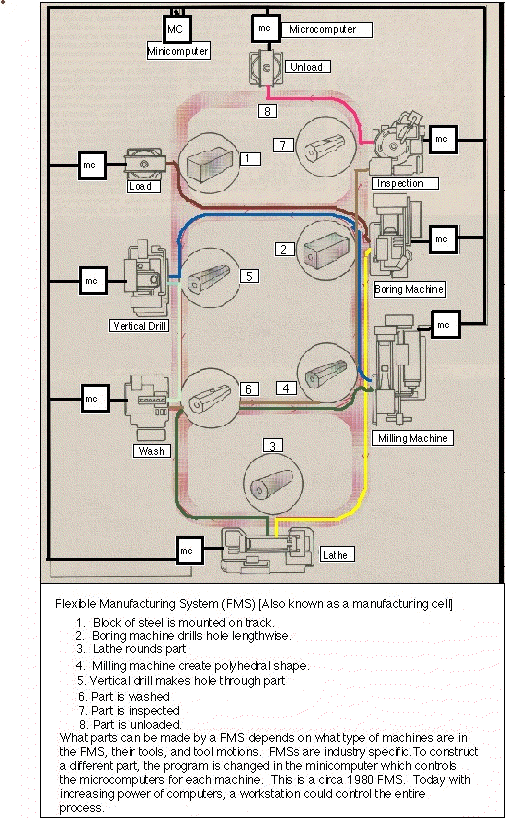
3. FMS: Computer controlled machine shop
A schematic drawing of an FMS is shown below. Remember each of
the machines shown is a general purpose machine that must be
programmed through the steps a-g listed above.
1. Skilled labor of machinist is incorporated into programmer.
2. Less labor
3. More efficient machine use
4. Once progams debugged and machine tools sharp, fewer errors.
Impact: Shift production from inventory to final demand.
Switching production from one time to another: A fundamental issue in production for final demand.
In the 50s Shigeo Shingo (1985) developed the SMED (single minute change of a die) system to reduce the required time and cost to shift a machine from the production of one product to another in less than 10 minutes.
Importance of reorganization
Some interesting sites to surf for FMS are:
Right part to the right place at the right time
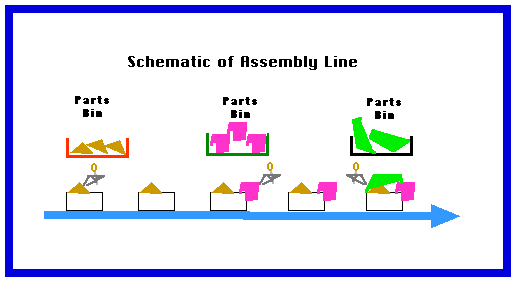
US until the 80s--bins correctg errors at the end of the process.
Japan: JIT.
Rest of world:
MRP
MRPII
a. Just in time parts delivery
b. Linear production system
c. Good environment for workers.
The first Mac had about 500 parts. To supply the parts to the linear assembly line, Apple installed three automatic parts delivery systems and one manual system:
a. Totes or plastic bins: These stored electronic parts
b. Overhead rail: This delivered bulkier items.
c. Automatically guided vehicles (AGV): Delivered other items
d. Humans delivered screws once a month or so because automating this delivery would be too expensive.
The trend in automatic delivery of parts is in making advances in AGV systems
and automatic warehouses. To eliminate the possibility of a Murphy's Law type
foul up, parts should be handled twice: when they arrive and when they are installed
on the product. When they arrive, they would be placed in an automatic warehouse
until needed. The program controlling the assembly process would send parts
automatically to the various assembly sites as needed.
Current leader Dell
US: not much emphasis on quality
German: quality associated with more inspectors and more cost.
Japan:
1. adapted statistical quality control: Deming
2. design for quality: S. Taguchi
3. Shigeo Shingo (1986) created the Poka Yoke
4. Reduced cost and raised quality
Since the 1980s US and European firms have imitated Japanese quality control concepts. For example, the quality of US automobiles has greatly improved and is slowly closing on the constantly improving Japanese quality standards. Currently, the Europeans have created an international quality standard called ISO9000. Many US firms are becoming certified as having met these standards.
Some interesting sites to surf for parts coordination and quality are:
Many of you have gained your impressions of robots from watching science fiction movies. Before reading the material on robots, you should first view some robotic animations .
From these videos it should be obvious to you that your hand
has much greater dexterity than a robot hand. Also, a great deal of
effort is required to get robots to perform tasks that humans
consider very boring.
Once programmed, however, a robot can perform a task repeatedly
without getting tired or bored.
An industrial robot is generally an arm with a gripper and some
capacity for movement such as straight lines and rotations. Japan has
been successful with robots capable of two straight movements and two
rotations; whereas, the US is going for all 6 degrees of freedom.
More advanced robots have microprocessors as brains. Sequences of
motion for the robot can be programmed into memory by leading the
robot through the desired sequences or programming the robot. Even
more advanced robots have artificial senses such as sight, touch, and
force.
A fundamental problem in the assembly of industrial products is
fitting pieces with close tolerances together such as gears or
placing a weld in exactly the correct place. A human is an excellent
assembler because we automatically make minor adjustments in position
to fit parts together correctly. If a robot without sight tries to do
the same it must know exactly where the two parts are in space and
the sequence of motions to fit them together. Lacking the ability to
make corrections, the robot can easily jam or wedge the two parts
together. The initial progress in assembly automation was with robots
without senses. These initial successes required considerable effort
to overcome the orientation problem.
Robots without senses are currently used in painting and welding
automobiles. In painting, the robot is superior to the human because
the robot does not need a fresh air supply and protection from
dangerous chemicals. Moreover, painting is tolerant to deviations in
the positioning of the paint gun with respect to the automobile
frame. In welding auto frames together, the robot is also superior
given the strength required to handle the welders and the adverse
conditions under which the welds must be made. The equipment to have
the frames exactly aligned to make the welds costs much more than the
robots. Also, Kawasaki was able to program a robot without senses to
assemble a motorcycle gearbox by having the robot gripper vibrate
slightly to compensate for inaccurate positioning.
Advances in the use of robots in assembly have required the
development of robots with senses. When a human assembles a product
or component of a product, he or she can usually identify the
component parts instinctively without much thought. To create a
program which gives a robot the capacity to pick up randomly arranged
parts is a major undertaking. To provide a robot with a camera so
that it can see is no problem. What is a problem is providing the
robot with the machine intelligence to interpret the input from the
camera. One solution is to have the parts to be assembled arrive in
exactly the right orientation. This is expensive; thus, while
acceptable for mass production, it is inefficient for batch
production. Some success is being achieved at creating machine
intelligence that can recognize parts in an arbitrary setting. Work
is progressing to give robots such senses as sight, touch, and force.
With these senses, a robot can be programmed to make minor
corrections to the sequences of steps it makes.
Much current success in assembly by robots with senses is achieved by
greatly simplifying the task of identifying alternatives. In
production this can be achieved by using bar codes similar to the
ones used in grocery stores. Bradly-Allen has a plant which
automatically assembles many kinds of controllers for electric motors
on the same assembly line. Robots know which sequence of operations
to perform on each product coming down the assembly line by reading
the bar code on the product. Robots with senses are also used for
quality control checking in this plant.
IBM created a plant here in Austin that employed robots with senses
to assemble laptop computers. The robots were controlled by PC-ATs.
This technology will probably be used to assemble all IBM personal
computers in the near future. Without significant labor costs, IBM
can compete with the clones. Robots, once programmed, put the right
chip in the right slot - something humans do not always do. As the
number of component parts in electronic goods is generally small,
robotic assembly in this area will proceed quickly.
Robots can currently assemble electronic products such as laptop
computers, gear boxes, electric motors, and other components. With
each new plant to assemble a product such as an auto, more and more
of the assembly will be automated. Since robots are not humans, the
jobs that they do best differ from jobs that humans do best.
Furthermore, the best assembly by robots frequently requires a
complete redesign of the product and manufacturing procedure to take
advantage of the capabilities of robots. This product redesign
usually involves simplification and reduction of the number of parts
and consequently, usually results in greater reliability.
Some interesting sites to surf for robotic assembly are:
This is the hard part of automation. Advances are taking place in
each of the steps of automation. Integration of all the steps is
currently impossible because the various types of machines are
incompatible. One step in the advance of automation and the
integration of steps is the creation of standards. Standards in the
marketplace are determined by professional groups or the dominant
player. IBM, the dominant player, set the standards for PCs.
Standards have been established for CAD graphics. GM has devised a
language called MAP so that all machines in manufacturing can talk to
each other, and this protocol has promoted the development of
manufacturing communication standards. Standards ensure compatibility
between equipment, and small players adopt the standards to ensure a
market for their products. Standards allow the small firm to
specialize in a niche market knowing its equipment will be compatible
with whatever equipment comes along. Currently (1995), there are
several competing protocols for factory LANs.
Standards for CAD drawings have been adopted industrywide and now CAD
is being integrated with FMS. In 1992 after a 5 year research program
costing $3.5M, a research group at a Dutch university created a
startup to market their program which would create the software to
run a FMS to create a part designed in a CAD program. Their software
can be updated and extended to accommodate different types of FMSs.
This product is at least 10 times faster than a human planner.
Advances in software to take CAD designs to create the software to run the machines to create the part is directly related to advances in 3D CAD software. A good article that explains this is "The Ultimate DNC; Direct CNC Networking (DCN)" Read Greco Systems's discussion of reusable software is this industry. MDSI has a good discussion of why open software is desirable in this industry. Read "A shop with a nervous system" to get further insights into current developments. One trend is upgrading older machines that were controlled by paper tapes with computers. Shop floor automations is active in this area.
Complete CIM must solve the data problem. A completely automated
plant from design to final assembly requires a massive data base with
all the designs, the programs to create the parts from the designs,
the programs to route the parts to the assembly line, and the
programs to assemble the final product. Moreover, this database must
be integrated into the office database for sales, accounting and so
on. In a completely automated factory, once the design is complete, a
program would take that design and automatically create all the sets
of instructions for all subsequent steps. The achievement of this
goal is some indefinite time in the future. However, more and more of
the paperwork associated with manufacturing is shifting to
electronics.
A recent invention in software tools for manufacturing is the creation of digital factory software to simulate the production process and layout. We use this term generically even though Tecnomatix has a trade mark on the term, digital factory. The use of digital factory software has lead to innovations in manufacturing:
Leaders in the field:
Some interesting sites to surf for CIM are listed below. Remember, these are partial and not total solutions to CIM:
In the renaissance in American manufacturing starting in the mid 1980s, US firms imitated the Japanese innovations. For example, Chrysler created Japanese style design teams to greatly accelerate the design of new cars. Firms in the US became converts to quality control as they discovered that consumers preferred quality Japanese products.
The US firms exploited their lead in software to innovate in production in beyond the Japanese approach. Because US suppliers are generally not near the assemblylines US reduction in inventory and work in progress was promoted by software programs starting with material resource planning, MRP and advancing to supply chain management software programs of today. Because US supplier firms are generally not adjacent to the assembly plant it is not possible to reduce inventory to the Japanese levels because of the possibility of transportation mishaps. Firms like Dell have their suppliers keeps supplies adjacent to the Dell assembly area and pay for supplies as they are used, McWilliams(1999). In some cases the supplier¹s 18 wheeler rig is parked at the factory.
Using their lead in software, American firms made innovations culminating the innovation of production for final demand. The application of software to soft as opposed to hard automation increased the trend for rapid changeover from one product to another at lower cost. One example is the use of industrial bar codes to simplify the machine intelligence problem of having each machine perform the correct procedure in assemblylines with multiple products. Another example is the software controlled flexible manufacturing system. Another is factory simulation programs created by Aspen Technology (1999), Dassault Systemes (1999), and Tecnomatix (1999) that allow industrial engineers to simulate the factory organization. Use of factory simulation can greatly reduce changeover times, not just of a single machine but an entire factory. In the auto industry the use of factory simulation programs has the promise of reducing the changeover in product production from 8 weeks to 48 hours, see Ross(1998). With soft automation the cost of batch production is falling to the level of previous mass production so that firms under the aegis of total quality management of pleasing the customer are increasingly producing for niche markets.
The culmination in the production for final demand comes about by the use of advances in communication for sales. Dell is one of the first firms to produce products exclusively for final demand and not inventory. At first customers ordered their build to specifications computers via the telephone. Then with the advance of E-commerce on the internet, Dell began selling through the Internet Their software is developed so that it aids the customer in choosing the most appropriate computer for their needs and allows the customer to follow their order through the production and delivery process. In the 21st century we forecast that production for final demand will become a increasingly common manufacturing practice. Remember some manufacturing may always be more suited to production for inventory than production for final demand.
In the later part of the 20th century the US government has many steps to promote invention and innovation in manufacturing. One example, is funding for Sematech (1999), a consortium promoting integrated circuit production. The Defense Advanced Research Projects Agency, DARPA (1999), funds numerous inventive and innovative activities in military production that frequently also have broad applications in the private sector such as Agile Manufacturing promoting lean manufacturing and rapid changeover. The Department of Commerce has initiated the manufacturing extension partnership, MEP (1999), to promote innovation and imitation in small firm manufacturing.
The innovations leading to production for final demand in firms producing multiple products create a difficult scheduling problem of operating factories shifting from one product to another satisfying customer demands, minimizing inventory and at the same time fully utilizing the production resources. In their most general form, a resource-constrained scheduling problem asks the following question: given a set of tasks, a set of resources and constraints and a measure of performance, what is the best way to assign the resources to the tasks such that the performance is maximized. Formally operation researchers have devised a variety of formal models of industrial scheduling problems such as varying in such factors as the types of machines, their operations, delays, information flows, deterministic or stochastic elements, for example see Dorn and Froeschl(1993).
Planning and scheduling have profound importance for projects consisting of several tasks and constraints associated with them. On a factory floor, determining which jobs to execute in what order on which machines and which employees to assign to a certain job, can mean the difference between profit and loss. Even for relatively small projects, however, the number of possible courses of action quickly become so overwhelming that it becomes almost impossible to achieve an optimum solution. In general, scheduling problems are NP-hard i.e. no algorithm exists that can find optimal solutions to these problems in polynomial time. Heuristics exists for solving exactly some forms of the problem but typically they become intractable(i.e. take more than polynomial time) when additional constraints are added or the problem size grows. As a result, most research has been focussed on either simplifying the scheduling problem(mostly by making assumptions) to the point that it is solvable by some algorithm within reasonable time limits or devising efficient heuristics for finding acceptable (not necessarily optimal) solutions.
In this section, we will briefly discuss the advancements in scheduling and the resulting performance gains. The point to note here is that a scheduling problem with reasonable number of tasks is usually so complex that the most sophisticated scheduling heuristics and fastest machines do not give us the optimum solutions- they only give us better solutions. Usually a move from one scheduling paradigm to the other involves huge investments in time and money and has profound impact on the functioning of firms and of the economy as a whole.
Although the roots of the scheduling problem can be traced back to prehistoric times, active research in this field began with the creation of digital computing machines after 1950. Linear Programming became the first formulation of scheduling problems with the invention of the Simplex algorithm by Dantzig in 1947 that provided efficient computation. Other important early Operations Research methodologies were Monte Carlo simulation techniques, stochastic optimization, queuing theory, Integer Programming (Gomory, 1958), Dynamic Programming, Bellman et al.(1982) and a several combinatorial methods, notably, Balas, (1969) and Branch-and-Bound methods, e.g. Land and Doig, (1960), Little et al., (1963), Barker and McMahon, (1985).
The principles and method of dynamic programming were first elaborated by Bellman in 1950s. For combinatorial scheduling problems, dynamic programming algorithms have exponential computational complexity because in order to calculate the optimal criterion value for any subset of size p, we have to know the criterion values for each subset of size k-1. Thus, for a set of n elements, we have to consider 2n subsets. The branch and bound algorithms divide the problem into several subproblems and calculates the lower bound for each of the subproblems. This procedure usually generates a huge tree. The computational complexity of a branch and bound algorithm is also exponential. Branch and bound methods are therefore limited to less than one hundred activities or even fewer in the multi-model cases. Other enumerative methods also suffer from the exponential computational complexity for reasonably large problems.
Unfortunately most scheduling problems especially the most relevant ones belong to the class of NP-complete problems which are intractable since nobody has shown that a polynomial bounded algorithm exists for these problems. Exact solution methods are thus of limited practical relevance in obtaining better performance.
With the complexity theory developed in computer sciences,Edmonds (1965), Cook (1971) and Karp, (1972), the focus of research shifted from exact but intractable methods to approximate but tractable solutions. Interest in heuristic reasoning within computer sciences was prompted by outstanding researchers like Herbert A. Simon starting in the 1960s. Heuristic search tries to enumerate combinatorial search spaces efficiently by ruling out the areas with low subjective probability of containing an optimal solution. This application of the research in neuro-science and human symbol processing to computer science gave a strong boost to the field of artificial intelligence. Soon the techniques developed in artificial intelligence were being used to find better solutions for real world scheduling problems.
This class of methods comprises several related algorithms. Simulated annealing was proposed as a framework for the solution of combinatorial optimization problems by Kirkpatrick, Gelatt and Vecchi (1983) and independently by Cerny (1985). As the name suggests, the inspiration for this method comes from the Physics of cooling solids. "Simulated annealing allows the allows the algorithms to 'escape' from bad local optima by performing occasional cost-increasing changes. " Lewis and Papadimitriou (1998). Simulated annealing gives good approximations of the optimal in many cases. However the cost-increasing changes often result in great loss of efficiency.
Tabu search, a discrete version of simulated annealing, is a general framework, which was originally proposed by Glover and subsequently expanded in a series of papers. One of the central ideas in this proposal is to guide deterministically the local search process out of local optima (in contrast with the non-deterministic approach of simulated annealing). This can be done using different criteria, which ensure that the loss incurred in the value of the objective function in such an 'escaping' step (a move) is not too important, or is somehow compensated for. " Blazewicz, Ecker, Pesch, Schmidt and Weglarz (1996).
Genetic algorithms are inspired by the theory of evolution; they date back to the early work described in Rechenberg (1973). "They have been designed as general search strategies and optimization methods working on populations of feasible solutions." Blazewicz et al. (1996) The traditional genetic algorithms have often not been suitable for combinatorial optimization problems because of the difficulty in the representation of the solution. Several improvements have therefore been proposed. Local search heuristics or genetic enumeration have compensated for this drawback.
Evolutionary techniques like genetic algorithms and neural nets and other recent techniques like fuzzy logic are mainly being used in rule-based reasoning and expert systems. Due to the early success of evolutionary algorithms, researchers strived for a total automation. In the last few years, however, the focus has shifted to a more realistic scenario of decision support systems. Decision support systems use genetic algorithms and neural nets to help managers in decision making. Due to the massive explosion in the size and diversity of firms, modern techniques like decision support systems are increasingly becoming necessities for large firms.
We now wish to consider scheduling from the perspective of Simon's bounded rationality. Because in general scheduling is an NP hard problem, managers aided with computers can not obtain exact optimal solutions in polynomial time. Bounded rational behavior is the use of approximate algorithms. Innovations occur in bounded rational behavior with the development of better man aided by computer algorithms that lead to better performance, and in some cases optimal performance. We wish to demonstrate this with an examination of progress in creating better algorithms for the job-shop scheduling problem.
In general, the work in a job-shop is made-to-order rather than made-to-stock and thus has crucial customer delivery dates associated with it. The main challenge of scheduling job-shops is to minimize the lateness of the jobs and maximize the throughput, both of which can be measured in different ways. Job-shops minimize inventory while attempting to meet the due dates within the known capacity constraints. Job-shop scheduling is the paradigm of choice for companies with customer customizable products.
This problems directly maps to the classic parallel programming problem which attempts to schedule a certain number of jobs of varying lengths on a given processors in a given time span. This problem is formalized as below.
Statement of the problem:
Number m ‘ Z+ of processors, set J of jobs, each j ‘ J consisting of an ordered collection of tasks tk[j],1 £ k £ nj, for each such task t a length l(t) ‘ Z+0 and a processor p(t) ‘ 1,2,º,m, where p(tk[j]) ¼ p(tk+1[j]) for all j ‘ J and l £ k £ NJ, and a deadline D ‘ Z+.
Many real world scheduling problems are related to the job-shop scheduling problem. Most of the scheduling techniques developed in the last forty years have been used, with varying results, for solving this problem. Tracing the history of job-shop scheduling problem would thus give us a general idea of the improvements in scheduling in the last four decades.
The origins of significant interest in the job shop scheduling problem can be traced to the two well known benchmark problems consisting of 10 jobs and 10 machines as well as 20 jobs and 5 machines. Both of these problems were introduced by Fisher and Thompson (1963). While the case of 20 jobs and 5 machines was solved in 10 years, the instance of 10 machines and 10 jobs took 25 years of extensive research to solve. Better solutions of the later case are still being explored. Lageweg in 1984 found an optimal schedule of 10 by 10 problem that Carlier and Pinson (1989) proved to be optimal. They used the branch and bound method to solve the problem. Since then several other branch and bound algorithms have been applied to find better solutions to the problem. Carlier and Pinson (1991) showed that the problem can be solved to optimality within less than 2 minutes of CPU-time on a small work station.
As approximation methods became popular in the early 90s, researchers applied them to solve the 10 x 10 job shop problem. The efforts to apply simulated annealing, tabu search, parallel tabu search and genetic algorithms culminated in the excellent tabu search implementation of Nowicki and Smutnicki (1993) and Balas and Vazacopoulos (1995). They achieved greater efficiency.
The job shop scheduling problem remains one of the most difficult combinatorial problems to date and arouses new research interest. The exact solution methods perform well only for some specific instances of the problem of the same size. They usually perform poorly for the instances of different size. Heuristics such as simulated annealing, tabu search and genetic algorithms are generally more robust under different problem structures and require only a reasonable amount of implementation work with relatively little insight into the combinatorial structure of the problem. Instances of the problem larger than 10 x 10 proposed among others by Adams, Balas and Zawack (1988) still remain open. There is thus continued interest in the problem as more efficient and robust solutions are being explored.
The approximation algorithms have not only facilitated the adoption of new manufacturing paradigms for firms, but have acted as major catalysts in the conception and implementation of new paradigms. Advances in the approximate scheduling methods have facilitated the gradual implementation of production of final demand.
Today markets are turbulent and dynamic. Tremendous advance in the field of information technology, microprocessor technology and artificial intelligence(application to scheduling and decision support) in the last decade or so have turned the vision of agile manufacturing into reality. It is increasingly becoming possible for the firms to achieve short product development cycle times and respond immediately to sudden market opportunities (Agility Forum, 1994). With time we are achieving better solutions but we are still far from the optimal. It has taken more than 40 years and billions of dollars in research and development for firms to reach this stage and there is still a long way to go. The scheduling algorithms are still far from being optimal in the general case.
Much innovation is creating better approximations to difficult problems. We use scheduling because the problem is clearly defined, but we strongly assert this applies to a large number of problems, which may not be clearly defined, that firms face.
After WW II, US manufacturing managers assumed they were the
greatest and became smugly complacent. Because the Japanese and
European manufacturing plants were destroyed during WW II, the US
firms initially had little competition and US firms could sell all
they could produce. The US made no attempt to innovate new approaches
to manufacturing. In addition, US firms padded the number of levels
of management to justify higher salaries for the top managers and
build bigger empires of flunkies reporting to each manager. They
granted organized labor wage settlements out of line with
productivity advances. Until recently most US business innovations
were in the area of finance with the automation of asset markets,
corporate mergers, and junk bond finance.
While the US manufacturing firms went to sleep, the Japanese built
new plants with an innovative approach to manufacturing. These
innovations in manufacturing should be considered as important as the
19th century US innovations in assembly line manufacturing and
replaceable parts.
The Japanese new production philosophy was built on revolutionary
approach to quality control, flexibility and short product cycles. We
have already discussed the Japanese reorganization to achieve total
quality control in their products.
a. Flexibility: The US standard for manufacturing was to
organize very long production runs to reduce the unit cost of setup.
The Japanese philosophy has been to create plants that could switch
from producing one product to another quickly. This eliminated the
need for production for inventory. (Japan with much higher cost of
land than the US has very high economic incentives to save space.)
The economic value of flexibility is that a firm can produce for
final demand and not for inventory. Better matching of supply and
demand results in better prices and greater profits.
b. Short product cycles: The Japanese firm organizes the
design and development of product in a design team that has
representatives from all functions of the firm. The team leader has
the authority to make decisions. Coordination between the various
aspects of the firm is automatic because they are represented in the
design team. A problem in the previous organization for design was
that the design team would finish the design and present it to the
manufacturing engineers to set up the production process. The
manufacturing engineers would take one look at the design and send it
back to the original designers with the comment we can not make this.
The two groups would then redesign a product which could be
manufactured. With design teams the coordination takes place before
the design is released to manufacturing.
In contrast, until recently the US firm with its multilevel hierarchy
had no one in charge in the design process. Conflicts would be
resolved by vice-presidents. Moreover, design was not coordinated
with other aspects of the firm such as manufacturing.
Since the 1980s the US manufacturing firms are playing catchup with the Japanese.
The one area in which we are ahead in software development in CAD, CAE and CIM.
The main US problems are:
a. Defective primary and secondary education system:Since the National
Commission on Excellence in Education published a report Nation
at Risk in 1983 condeming US primary and secondary schools as the
type of schools our worst enemy would create for us, there has been a movement
towards excellence in primary and secondary education. As discussion of primary
and secondary education is frequently heavily influenced by the political agenda
of the speakers, you should be very wary of taking the various claims at face
value. Let us discuss the issues:
a. Length of the school year: Primarily and secondary students spend on average 178 days in school a year, whereas most European children are in school over 200 days and Asian children over 240 days. But the OECD has produced a table showing that US children are taught more hours of instruction per year than many European countries. US children go to school for longer school day than their European counterparts.
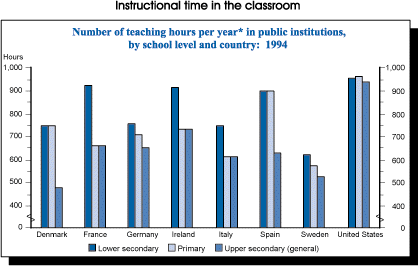
My understanding is that the US summer vacation, based on a long gone agrarian society, is so long that students tend to forget what they learned and must be retaught in the fall. As I see it the problem is creating a longer school year is finance. Teachers would have to be paid more and the public is not willing to fund this move.
b. US pays more to educate students and most of this extra cost is administration. In 1990 the US spent $5521 on pulic school education more that double (corrected for inflation) spent in 1965. The increase went to:
The residual of about 11% may well have gone to increased bureaucracy.
In considering the cost per student, you should keep in mind that in most states there is a tremendous variation in expenditures from the poorest to the richest district. Poor districts would do better with greater resources.
c. US students test at the bottom in math and science. In 4th grade US students test well in science and math, but by the time they are seniors they are at the bottom. But, US students are near the top in reading.
In considering these statistics, you need to remember that other countries tend to have more elitist educational systems where college bound students are selected at an early age and the rest are sent to vocational schools. One issue is whether the comparisons are representative. There is also a question how statistically significant the differences are with Europeans. Japanese study extremely hard in secondary school because the University that they enter determines their career. In the US Universities such a UT definitely pick up the pace from High School.
d. Improvements since 1983.
e. In informational society, if you do not have a good education, you are unlikely to find a well paying job. There is a great deal more that needs to be done to improve primary and secondary education. The conservative agenda is pushing for much more change that the liberal agenda.
In considering increased competition, you should remember that the Japanese primary and secondary education system is public. Research indicates that vouchers are primarily used by better off, better educated parents to take their children out of poorer performing schools. How well vouchers would work on a wide scale is an open question. Many parent may wish to place their children is schools where they are happy rather than obtain the best education.
Certainly we have a long way to go in primary and secondary education.
b. US MBA students are taught finance. The best MBA students until recently
wanted to go to Wall Street and only the rejects went into manufacturing. Moreover,
US managers have a short planning horizon that precludes making the necessary
investment to innovate in manufacturing.
c. Accounting for Automation: Until recently, US accounting practice
in manufacturing was defective because accountants were placing a value on automation
expenditures only for reduction in direct labor. They placed no value on increased
quality control and greater flexibility.
d. Poor Management-Labor Relations: Until recently the US management
style was top down in that managers gave orders to workers and rarely listened
to them. Labor unions created rigid work rules that made reorganizing the workplace
very difficult. In addition, executive privileges angered the workers. For example,
Japanese executives listen to workers suggestions, eat with the workers in their
cafeterias, do not have executive parking lots, and take pay cuts themselves
before asking the workers to take a pay cut.
Since the 80s, surviving US manufacturing managers are making a painful transition
to world class status in manufacturing. Accounting practice in manufacturing
has been upgraded. Manufacturing firms have been reorganized to imitate the
Japanese with design teams to obtain better products in much shorter time. Business
leaders are now painfully aware that they must work with politicians in order
to improve the
educational process. Universities are now emphasizing manufacturing. We
are talking about a decade or two before significant progress in education reforms
will be realized. That is why as a patriotic citizen, it is my duty to get
you students to do some work!
Innovation in automation is a difficult task for a firm because a major renovation
of an old plant is expensive, and creating a new plant is very expensive. To
achieve sufficiently better performance such that the investment can be considered
an innovation, requires much practical learning through experimentation to achieve
the potential of the new equipment. Because firms need to justify their investments
to stockholders, they need to achieve better performance within the time span
of a year or two. Given the constraints on managers, manufacturing innovations
are generally a sequence of small advances.
GM through its mistakes
illuminated the problems of manufacturing innovations. GM, early in the 80s,
set a bold strategy for manufacturing innovation. They were going to make major
steps to automate manufacturing operations to achieve two objectives. First,
they would leapfrog the Japanese, and second, they would solve their labor problems
(rigid work rules and a rigid seniority system) by eliminating labor as a significant
factor. After a $40B investment the magnitude of GM's mistakes are now apparent.
They tried to advance automation too quickly. They implemented production technology
that was beyond the state of the art. Because the technology was untried, they
had to spend $Bs getting it to work. Instead of running factories to produce
goods to make a profit, they were forced to run the factories as experiments.
To make matters worse, GM entered an agreement with Toyota to make Corollas
and Prisms (Novas) in an old factory in California. Toyota supplied the managers
and GM supplied the workers. The Toyota managers modified Japanese style management,
which emphasizes teamwork, flexibility and good upward communication, to achieve
Japanese levels of quality with little automation. Toyota immediately used the
acquired knowledge of North American laborers to set up successful factories
in Kentucky and Ontario. GM finally wised up and used the new management labor
relations in their successful Saturn plant.
Innovations in manufacturing require much more than trying to replace existing
equipment with more automated equipment. A major source of innovation in manufacturing
is better organization and better use of humans. One example of an organizational
innovation is the creation of decisive design teams with executives from all
parts of the firm. This greatly reduces the design time are results in market-oriented
products which are easier to manufacture. In organizational areas US manufacturing
firms are imitating Japanese firms.
Automation will gradually decrease the cost of batch production to the level
of mass production and create much greater flexibility in manufacturing. Flexibility
is needed to enable suppliers to more rapidly respond to changes in demand.
For example, Chrysler spent $160M to enable an assembly plant to shift between
two types of cars. In the limit (several hundred years), you will be able to
design an object at home and have the object manufactured automatically at mass
production prices.
Some interesting sites to surf for competitiveness are:
Automation will affect all industries manipulating physical
objects. Consider agriculture first and the harvesting of tomatoes
for ketchup in particular. To build a machine that would mechanically
harvest tomatoes, the first step was to engage the geneticists to
create a tomato vine on which all the tomatoes ripened at the same
time. This enabled the machine to cut the vines off and shake off the
tomatoes. The problem with the first tomato vine with tomatoes that
ripened at the same time was that they tended to split open when they
fell from the conveyor belt into the truck. This necessitated going
back to the geneticist to obtain a tomato vine on which all the
tomatoes ripened at the same time and all the tomatoes had thick
skins. The third round was to obtain a tomato that was square and
would not roll off the conveyor belt. Does the tomato taste good?
Well, maybe in the future they will address that problem. Work is
progressing on machines to harvest oranges and other fruits.
Construction will probably be automated more slowly than
manufacturing. Manufacturing takes place in much more controlled
conditions and the number of contingencies are less than in
construction. Construction will be automated by creating modules in
factories to be assembled on site. The handling of physical objects
in the services is also being automated. Utilities such as electric
power generation are similar to continuous process manufactured items
and are highly automated. Computers have made possible the shipping
of sealed standard sized containers. RR cars are also controlled by
computers. Warehouses have been automated. At Federal Express, the
sorting of packages is automated for overnight delivery.
Some interesting sites to surf for automation in agriculture and the services are:



Next: Auto-Information
Up-Info: Info SocietyPrevious:
Communication