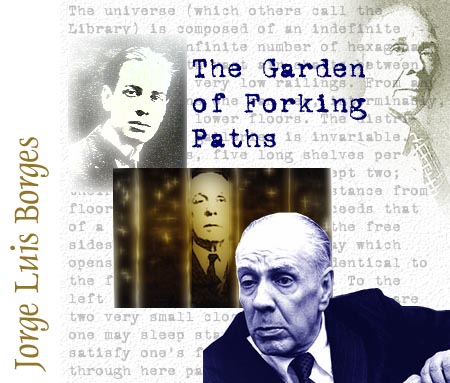
Jorge Luis Borges (1899-1986)
Best known for his creations, usually in very brief short stories (speculative fictions) that imagine a world where “reality” is a tenuous or questionable concept. Reality is replaced by “possibility,” by “realities,” by the rich potential that is created in the fertile mind of the thinker/speculator.
In “"Tlôn, Uqbar: Tertius Orbis,"” for instance, a narrator comes across evidence of a world in existence in his present that has been called into being by a group of thinkers (encyclopediasts) who have been commissioned by a wealthy man to prove to God the paltry nature of his own creation. These men in concert create a world where physics and metaphysics both are quite different than they are in our world, where differences in language create absolutely different perceptions. With the discovery of the Encyclopedia of Tlôn, the world as we know it begins to adopt traits of Tlon, and the old world is fading in favor of the new.
Or in “"Pierre Menard, Author of the Quixote,"” a turn of the century author embarks on an undertaking where he succeeds in re-imagining and writing Don Quixote--not copying it, but writing it. He succeeds in writing a book that is, word for word, identical to that of Cervantes. But, owing to the different historical time in which it is written, it is considered by the reviewer to be more ambiguous, hence infinitely richer, than the book by Cervantes. The reviewer goes so far as to compare passages, which are indeed identical, while making claims for the superiority of Menard's text.
--stories almost always involve a text as a main figure.
Biography
--Perhaps due to Borges childhood in Argentina, where he testifies that in his earliest days his playground was the vast library kept by his father, both a lawyer and a man of letters. The library and the garden.
--Learns English along with Spanish. Maternal Grandmother was British.
--His family in Europe at the outbreak of WWI and is trapped there, so he goes to school in Geneva, Switzerland, where he adds French and German to his languages.
--Spend some time in Spain after the war, where Borges becomes involved with Ultraism, a movement of experimental poetry against the middle class conventions they thought were supported by Spanish realism and sought a kind of other reality in the metaphors and artifice of poetry. A little of “art for art’s sake” in their philosophy.
--Returns with Ultraism to Argentina. Involved in a journal who published their work on huge wall murals (first putting the writings on sign paper.
--Borges the librarian. Becomes a librarian to support himself from at least 1938. Then When Juan Peron, against whom Borges had written and spoken (characteristically he is non-political in his work) comes to power (1946), he deposes Borges and offers him a job as chicken inspector instead. Borges passes on that, finding work as a teacher.
--With Peron in exile, Borges is given the post of National Librarian (1955). Soon he begins to lose his sight (due to a congenital disposition to do so) and becomes, ironically, the blind librarian. More ironically still, he is the third of Argentina's national librarians to suffer from blindness.
--In 1976 Peron returns to power, and Borges resigns to spend the rest of his years traveling, teaching, writing. Some of those years were spent teaching at the University of Texas.
“"The Garden of the Forking Paths"” is the title of his first major collection in 1941. The story itself also won, a couple years later when translated, second prize in the annual Ellery Queen Magazine annual mystery story contest. Typical of Borges for its main idea centered around a kind of speculative, philosophical question, its use of the book as a device, its use of the labyrinth as a device, and a kind of open-ended quality, which invites the reader to devise elements of their own speculation inspired by the story.
And in a sense this idea, that there may be different worlds where different choices are made, is not altogether original.. One might say that the treatment is, however. There is the complexity (see map). There is also the beauty of the thought expressed intermittently (652-3, the speculation on “now”). Now becomes later, the subject for thought on the future (italics, 654). There is the Borgesian potentialities of such things as the labyrinth in Tsun's speculations (ruminations on 655). And there is, even in the creation of the novel of Ts'ui Pen, not simply a novel which describes a labyrinth, but an interesting novel which is at all points an astute commentary on human nature (see descriptions of the battle on 657).
The “invisible, intangible swarming” experiences by Yu. Is this because of the reality of the Labyrinth, or is it due to the power of suggestion (the possibility or potential) that he feels the innumerable variations on his own experience that had been possible?
Look at the maze constructed by Borges, which at the same time is one in which, at certain passes, there also exists the mirror.
