




Human life is dominated by the will. Since the noumenal something of which we are the phenomenal embodiment is unknowable and inapprehensible what do we call it? –– Schopenhauer called it the will (because the will-to-life seems to be the ultimate impulse we can discover in ourselves). The will manifests itself in the phenomenal world as desire. Desire permeates human relationships such as love and sexuality. Desire does produce temporary pleasure, but it is also tragic, the root cause of human suffering in that it can never be satisfied.
Schopenhauer wrote that desire and the suffering it causes cannot be comprehended intellectually, but artistic contemplation can take one temporarily to a will-less state where the "why" question (ultimate cause) is suspended in favor of the "what" of existence. Music as the only non-representational art can provide a copy of the Will and an Idea of the world in its totality (noumenon).
In Tristan Wagner uses dissonance to represent unfulfilled desire. The most important musical material in the work is the desire music; it occurs at the very beginning and includes the Tristan chord. It is not "satisfied," i.e. the dissonance is not resolved, until the very end of the opera. Arguably the most famous chord in music history, it is important to note that the Tristan chord is not completely dissonant. The representation of dissonance that Chafe gives as an analogy to negation is the diminished-seventh chord. The diminished-seventh chord is made up of three minor thirds, or, a diminished triad with a minor third on top. The Tristan chord is a half-diminished-seventh chord. The half-diminished-seventh chord is made up of two minor thirds and one major third, or, a diminished triad with a major third on top.
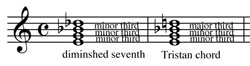
“In the desire music and throughout much of Tristan the diminished-seventh chord and tritone serve as harmonic symbols of atonality and negation, whereas the Tristan chord and the dominant-seventh chord reflect the urge toward key centers that remain largely unfulfilled until the end.” (Chafe 94) This serves to increase the tension created by the music. Yet another dualism to add to the list of those present in Tristan und Isolde is tension vs. release. These map onto atonality vs. tonality, and the Tristan chord falls somewhere in the middle. It is not a complete negation of tonality, but creates even more tension by implying tonality that is not realized.
Wagner accepted most of what he found in Schopenhauer but not all. Chafe refers to Wagner's "amendment of Schopenhauer" (45), viz. that sexual love rather than compassion is the key to transcendental change.

